

On a cold, drizzly early spring day, visitors to the Portland Museum of Art browse exhibits on American Art and line up to view a noon film in the small theatre.
But not me. Mike Brown, director of campus sustainability, is leading me through the bowels of the basement, weaving around industrial-sized metal pipes.
"So right now, you're a full two stories below," he told me. "And then we drop these last 8 feet."
This is where the museum's air is heated, cooled, humidified, or dehumidified, depending on the day.
"The reality of it is, we only have about an hour and a half of ideal temperatures [for the art] each year. So the rest of the time we're conditioning that air," Brown said. "We're either adding heat or cooling or adding humidification or subtracting. It is a very energy intensive process."
We step into the windy dark of a giant metal vent the size of a walk-in closet, where fresh air is pumped down from the outside, then processed.
""It's all fun and games until someone closes the door," Brown joked, before pointing out the technical aspects of the air shaft. "There's a pre-heat coil, a chilled water coil, and a reheat coil, that then gets pumped back out into the museum."
An identical giant vent across the room processes air that is already inside the museum. That air is constantly filtered and re-circulated through the system, too, keeping it at the perfect temperature.

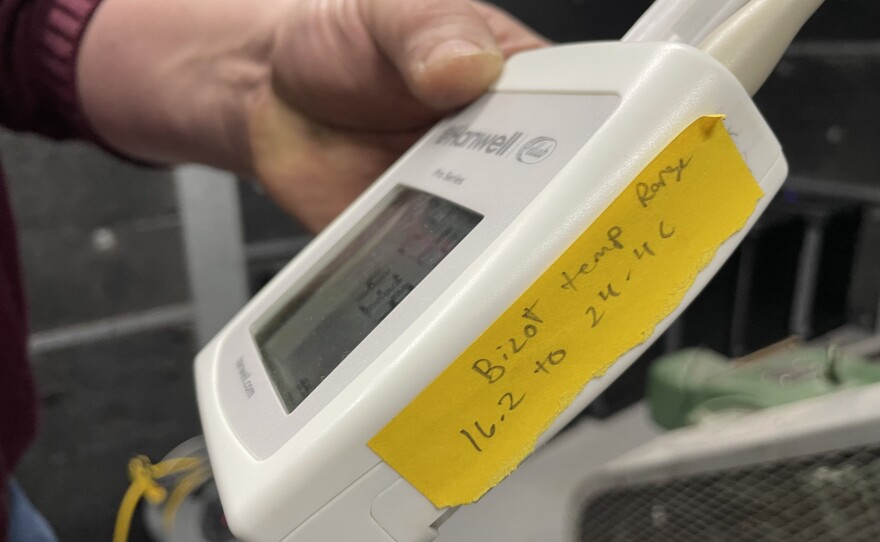
For decades, museums around the world have maintained strict climate control standards: an even 70 degrees and 50% relative humidity.
But last year, the PMA began a process that few museums have dared to try: widening those long-held temperature windows to fit the climate-friendly guidelines called the Bizot Green Protocol. Now, the PMA uses a wider standard: between 61 and 77 degrees Farenheit, and 10% above or below that 50% humidity mark.
"Those outer limits, I do view those as guardrails," Brown explained. "We have no desire to even bounce off of them."
Created at COP in 2015 — the annual United Nations Climate conference — by an international consortium of museum directors from places like the Met in New York, the Louvre in Paris and the National Gallery in London, the Bizot Green Protocol is intended to reduce energy needed for heating, cooling and maintaining humidity.
"The scientific evidence that we've had for updating climate control parameters has been around for more than 25 years," said Caitlin Southwick, founder of Ki Futures, a non-profit dedicated to promoting sustainability in museums. She runs trainings to coach institutions through adopting the new protocols.
"Museums have been kind of thinking about this since the early 2000s but you know, it was one of those points that it was like, if it ain't broke, don't fix it."
An art conservator by training, Southwick had worked at museums like the Uffizi, the Getty and even the Vatican. But in the course of her work, she started to realize the toll her field was taking on the planet.
“I used to work at a research center where we used three times more energy than a hospital,” she said. "When I tell people that museums use as much energy, if not more, than a hospital, people are quite shocked," she said.
"Energy is, from the museum perspective, the biggest carbon footprint, and it's probably the least known.”
Through implementing the new energy-efficient standards, the PMA has been able to cut its energy usage by about 20%, freeing up tens of thousands of dollars for other uses, like programming and exhibitions.

Erin Damon, head of registration and collections, said it was scary at first to make the changes -- no one wants to be the one to damage priceless art.
"I think it was met initially with a lot of trepidation and concern," said Damon. "We weren't really sure how those if you put those guidelines into practice, how your collections would react?"
But the team at the PMA has been able to implement the Bizot standards without any discernible effects on the collections. And, Damon's team has figured out other ways to protect individual pieces as well.
Like Winslow Homer's 1884 Taking an Observation, which is oil paint on wood and was originally installed on a sailboat. The conservation team has sealed the back of the painting in its own microclimate.
"We're not altering the work itself. We are altering the package that the work is encased in with the frame and the specific glazing and the special tape on the back, to decrease any of that moisture coming in," said Damon.
Damon and Southwick agree that the science now shows that the older, strict climate controls aren't even best practice for collections preservation - a clay sculpture, a wooden frame and an oil painting all prefer different conditions.
"It's very object specific," Damon said.
Southwick said there are more museums beginning to work on implementing the Bizot standards, but it's a slow process.
But, she said, cultural institutions used to think of themselves as having a small carbon footprint.
"The reality is, is that that's not the case anymore. There is not a single person or industry on this planet that is exempt from working towards a better future."
Brown says the Portland Museum of Art is continuing to look for ways to become more energy efficient. And with an upcoming expansion to the building next door, the team is looking at green energy options, like geothermal power, to power the whole campus in the future.
